
(An inquiry into the origins of Hindu religion, Caste System, Nationalism and Bharath Mata, along with a review of the philosophy of Sri Aurobindo and Mother)
In my first article on Auroville, I had mainly inquired into the sources of confusion in Auroville, like the lack of a substantial orientation program for newcomers, confusions in integrating money into community life and compromises inherent in the Auroville Foundation Act. These are some of the factors which have been weakening the community from within for a long time. The present article also is an exploration in the same direction.
Recently, I visited Auroville again. On one of those days, an Aurovilian on behalf of a community asked if I could do some research on The Soul of A Nation1, a topic articulated by both Sri Aurobindo and Mother. I was happy to accept the request for two reasons: one, it would give me an opportunity to further deepen my understanding of their teachings. Two, I have always been trying to make sense of this recent historical phenomena called nations and nation-states, and now I had the opportunity to bring these two inquiries together.
I started my research, rather innocently, by reading On Nationalism. It was a collection of articles on that topic written by Aurobindo Ghosh, the early name of Sri Aurobindo, before he moved to Pondicherry in 1910. Within a few minutes of reading, I was stunned and grew confused and frustrated, feelings which progressively intensified over the next two months. In the first hour, I realized that both Aurobindo, and the divisive, majoritarian Hindutva ideology are using similar ideas and categories to make sense of the people and cultures spread across the subcontinent. I noticed Aurobindo’s identification as a Hindu, how he stubbornly and effortlessly mixed-up nationalism and religion, and his reflections on Muslims, carrying an underlying sense of otherness – a marked difference from many of his contemporaries, including Gandhi and Rabindranath Tagore.
In his article The Hindu Sabha, Aurobindo questions the loyalty of Muslims to the Indian independence movement without substantiating his views with any verifiable material. He writes: The Mahomedans base their separateness and their refusal to regard themselves as Indians first and Mahomedans afterwards on the existence of great Mahomedan nations to which they feel themselves more akin, in spite of our common birth and blood, than to us (Hindus)2 3.
He writes about the caste system4 (Chaturvarnya), envisioned by ‘upper’ caste Brahmins, as if it was necessary and as something that had worked well at some point of time and only later degenerated into a dehumanizing system.
After the first hour of reading, I rushed to his later works, especially those from his last years, to see if there was a categorical shift in his views. But, before going into those writings and my reflections on the same, I think it is important for us to critically explore a few main concepts like Hinduism, Caste system and Nation, recurring themes in his works, with the aid of other scholarly sources like historians and linguists. Such an exploration may help the reader to see a consistent pattern in his contemplation and to better understand the scope as well as limitations of his works. A deeper understanding of those key concepts is also relevant in the larger context of the incessant attempts by the Hindutva ideology to (mis)interpret Indian history and to co-opt Sri Aurobindo for furthering their own agendas, including the usurpation of Auroville.
However, the following brief explorations of subjects such as Hinduism are only indicative. The purpose is to give the reader and future researchers a sense of direction; they are not exhaustive in nature.
Hindu and Hindu religion
The word Hindu originates from the river Sindhu, which flows through both modern India and Pakistan. Persians, who had to cross that river to reach the subcontinent called it Hindu, and Hindus were those who lived across that river. That is, Hindu was a geographical term and had nothing to do with any religion. Hindu, may also have meant ‘the other’ in the eyes of the immigrants. Greeks called the same river Indus and those who lived across as Indian(s).
Compared to Semitic religions, the spiritual practices of the communities in the subcontinent varied considerably. (Absence) of a monotheistic God, of an ecclesiastical organization, of theological debates on orthodoxy and heresy5, were a few of the notable features which they more or less maintain till the present day. The Indus valley civilization, unlike its Mesopotamian or Egyptian counterparts, lacked huge, common places of worship, probably indicating a more private and decentralized nature of spiritual practices.
There was no idea of religious conversion either, which perplexed early Muslims who started migrating to India from the 7th century onwards. The people of India do not seem to have perceived the new arrivals as a unified body of Muslims. The name ‘Muslim’ does not occur in the records of early contacts6 – a sign of the absence of a collective religious identity among the populations here. The term used (for migrants) was either ethnic, Turuska – referring to the Turks, or geographical – Yavana… for Greeks and others coming from west Asia, or cultural – mleccha. The word Mleccha, meaning impure, goes back to the Vedic texts and referred to non-Sanskrit speaking peoples, often outside the caste hierarchy or regarded as foreign, and was extended to include low castes and tribes7.
This is not to say that a shared sense of community was absent among the various populations in India; it was interwoven by multiple identities based on caste, class, labor, guild, locality and language, as we have even today. It has been more of an amorphous sense of interconnectedness, which is different from having a primary, overarching, shared identity. Add to this situation, the sparse communication and transportation channels between various communities during that time or the natural language and geographical barriers. Then the picture we get is that of a loose network of more or less independent communities, distributed far and wide, dotted with commercial and political power hubs, freely contemplating and customizing their own cosmology or psychology according to their unique needs and preferences. These communities interacted – complemented, compensated, distanced, negated, and attacked each other in the realm of ideas and beliefs in resonance with their socio-economic realities. Through such an interactive evolution spanning centuries, shared myths and ritual patterns emerged, congruent with practical imperatives and integrations.
The gradual emergence of a Hindu religious identity
If we search non-Islamic sources, we would see that only from the fifteenth century onwards did people start referring to themselves as Hindus. Initially, it may have been a response to being regarded as ‘the other’. For instance, certain administrative practices of the Mughal empire (1526-1857) in its early and later days, like taxation of non-Muslims (Jizyah), may have facilitated the consolidation of such an identity8.
However, the identity of Hindu and Hindu religion, as we know them today, is something that gradually emerged over the last two centuries during the British colonial rule. In the late 18th century, The East India Company created a Muslim Law and was keen to codify a Hindu Law as well, mainly to facilitate taxation9. The then prevailing concept of law demanded that the laws be well aligned with the religious jurisprudence of the local people, which would make the regime, including its taxation, appear more legitimate. That is, the British were looking for a Hindu holy book similar to the Bible or Quran. Rising to the occasion, people belonging to the Brahmin-priestly ‘upper’ caste who were in different capacities functioning as the intermediaries between the British regime and the Indian population, presented their Manusmriti, a code of obligatory laws, as the common, ancient law of all Indians except Muslims. It was a win-win situation for both the British and the Brahmins. The British got what they wanted. For Brahmins by placing their book as the Book of Indians, posited themselves as the perennial, rightful authority in the subcontinent before the British regime, legitimizing their claims in the regime.
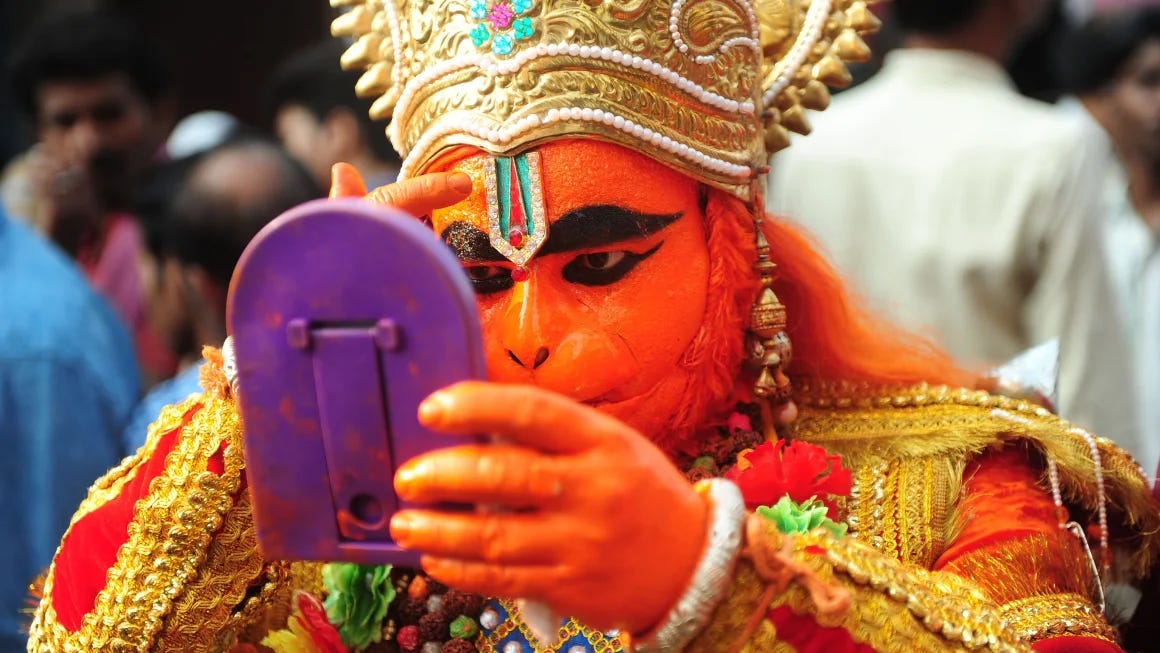
Photo courtesy: SANJAY KANOJIA/AFP/Getty
Another factor that greatly influenced the retrospective invention of an ancient Hindu religion was the publication of The History of British India in 1818, authored by a British named James Mill. The instantly successful book greatly influenced British people’s perception of Indians and the policies of the British regime in India.
James Mill periodized Indian history into three parts: Hindu, Muslim, and British, which practically means Christian, in reference to the dominant political powers and their religious backgrounds. He considered the whole Indian population as barbaric and British rule as a civilizing mission and thus wholly legitimate. In the essay, ‘Of the Hindus?’ , under the chapter General Reflections Mill wrote: under the glossing exterior of the Hindu, lies a general disposition to deceit and perfidy… the same insincerity, mendacity, and perfidy; the same indifference to the feelings of others; the same prostitution and venality10.
This seminal work had a paradoxical effect on Hindu-leaning, orientalist scholars. They liked the periodization based on religious backgrounds, since it explicitly lends authenticity to their claims of Hinduism being a perennial religion. On the other hand, the same work made them anxious to prove that Hindus had always been quite civilized. Christian missionaries considering Indians as primitive, since Indians lacked ‘proper’ religions, added to this urge of scholars to present a Hindu religion that would smoothly fit into a known Semitic model.
The British census initiated in 1865 was another colonial process that significantly contributed to the manufacturing of a Hindu religion. Through the many censuses conducted in the following decades, the colonial administration forced into existence a Hindu religion in its desperate attempt to make sense of the bewildering ‘chaos’ called India. The armed uprising against the British regime in 1857 added a special sense of urgency to the whole situation. In the General report on the census of India 1891, while explaining the methodology, the census commissioner helplessly states: The clumsy name (Hinduism) is only justifiable by convention, and only defined by the same process of successive exclusions as was used above with reference to the application of the term Animism11. Thus, anyone who did not belong to Muslim, Sikh, Christian or Judaism religions became Hindus. In the census of 1891, the percentage of the Hindus thus identified was 72.32%12.
In the nineteenth century, there had been many other strong currents emerging in the body politic, greatly encouraging the consolidation of a Hindu religion. Romila Thapar, in her essay Imagined Religious Communities? Ancient History and the Modern Search for a Hindu Identity, writes: The need for postulating a Hindu community became a requirement for political mobilization in the nineteenth century when representation by religious community became a key to power and where such representation gave access to economic resources… Once this argument was conceded, it became necessary to recruit as many people as possible into the community. Here, the vagueness of what constitutes a Hindu was to the advantage of those propagating a Hindu community.
General elections conducted by the British regime in 1920, to elect members to the Imperial Legislative Council and the Provincial Councils, had seats reserved for Muslims and Sikhs. Such religion-based policies of the regime, as well as notions of majority and minority communities, further exacerbated the making of a Hindu religion.
Caste System
The word Caste came to India with the arrival of the Portuguese13 from the 16th century onwards. Here, they found mutually exclusive groups (Jati)14 who generally would not inter-dine or inter-marry. There have been thousands of such castes or Jatis, based on ethnicity, occupation, class, and they were further influenced and altered by factors ranging from hypergamy to language and geographical location. The 1901 census recorded 1646 distinct castes, which increased to 4147 in 193115. Such independent yet interrelated communities had no fixed hierarchy but were subject to vague and fluid notions of rank articulated over time based on social, political and economic status or lifestyle. The fact that Muslims and Christians among others, also have castes16 is indicative of the presence of overarching yet diversifying identities which are more significant than any particular religious identity.
On the other hand, the idea of Varna (meaning colour), which is often misrepresented as a synonym for caste, has its origin in Brahmanical texts like Manusmriti. Manusmriti envisages the society as divided into four groups –Brahmins (teachers, scholars and priests), Kshatriyas (warriors and rulers), Vaisyas (farmers, traders and artisans) and Sudras (servants) – a classification which was never practically operational in India17. However, as it happened with the Hindu religion, the colonial regime which was clueless about how to make sense of the Indian population and its customs, applied those Brahmanical constructs to categorize and systematically understand them.
It is true that many Brahmanical groups have had considerable influence on different regimes.As legitimizers of political authority, Brahmanas in the first millennium A.D. were given grants of land, which enabled them to become major landowners. The institutions which emerged out of these grants such as the agraharas became centers of control over rural resources as well as of Brahmanical learning and practice. That is, participation in the ruling regimes over the centuries, and the power and wealth accumulated thus, placed many Brahmin communities in the upper echelons of the social strata. Though miniscule in actual numbers, this social capital gave Brahmins disproportionate say in matters concerning the larger population, including in the British regime. However, that is totally different from what the British regime tends to imagine, that for ages the whole Indian population has organized their practical lives within the Brahmanical categories.
W R Cornish, who was in charge of the census conducted in Madras Presidency in 1871, is apparently frustrated when he writes: The subject of caste divisions among the Hindus is one that would take a lifetime of labor to elucidate. It is a subject upon which no two divisions, or sub-divisions, of the people themselves are agreed, and upon which European authorities who have paid any attention to it differ hopelessly… Many learned missionaries and native officials acquainted with the habits and customs of the people have been consulted, and their opinions collated on definite questions, but the replies, as a rule, have been so contradictory as to raise suspicion in regard to the value of the testimony… In no work on the subject of caste has any attempt been made to reduce into order and classification the almost innumerable subdivisions which still go on extending amongst the people. The Committee of the Madras Town Census, aided by some native gentlemen, proposed in 1869 a system of classification, which, it was hoped, would enable the Government to obtain important information in regard to the great divisions of the people. The system proposed by the committee has been adopted both for the town census and for the Imperial census. It is not perfect, but it is, at any rate, an attempt at simplifying the abstruseness which now surrounds the whole question… The committee accepted, without question, the divisions of the Hindu community into (1) Brahmans (2) Kshatriyas, (3) Vaishyas, (4) Sudras, and (5) Out-castes18. Once again, as it happened with the Hindu religion, a fourfold caste system had become a time immemorial ‘Indian reality’. The classification suggested by Brahmins, also conveniently placed themselves in the upper layers of the power structure, as if that has been the case all the time, everywhere, substantiating and legitimizing their claims to power.
Nation
Nations and nation-building were favorite subjects for Sri Aurobindo, even in his last years. Curiously, like Hinduism, nation is also a recently emerged and engineered social reality that pretends to be an eternal aspect of human life. In the Dictionary of the Royal Spanish Academy’s edition before 1884… the word nación simply meant the aggregate of the inhabitants, of a province, a country or a kingdom and also, a foreigner. However, in its 1884 edition, it was given as a State or political body which recognizes a supreme center of common government and also the territory constituted by that state and its individual inhabitants, considered a whole, and henceforth the element of a common and supreme state is central to such definitions…19
In the same dictionary, the final version of nation is found only in 1925, and it is described as the collectivity of persons who have the same ethnic origin and, in general, speak the same language and possess a common tradition20. Evidently, like many other countries, India does not fit into this definition.
Both the idea of nation and its practical version nation-state, as we know them today, were things emerged out of the industrial revolution or exponential developments in areas like mining, communication, transportation and printing. It is also a result of revaluation of the cosmology of the Catholic Church by empirical science, which eventually effected the negation of the ‘divine’ rights of the King/Queen, and in the placement of those rights in the hands of the citizens.
If a modern nation can be defined as a population with a shared sense of community, then it is pertinent to consider the factors that create and maintain that sensibility. Such factors include school education that presents nation as a foundational institution of life, collective rituals like singing the national anthem, veneration of the colored cloths called national flags, entertainments by national sports teams, national organizations like political parties, practices like periodical elections, institutions like a central government and judiciary, and news media which keep the nation as a constant in the imagination of its consumers.
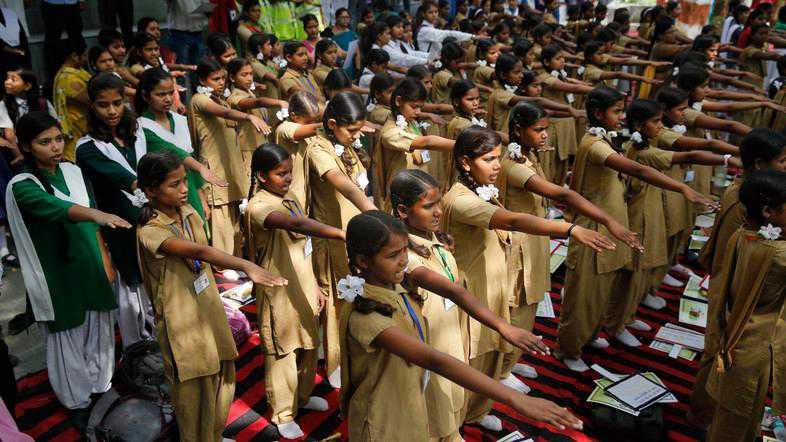
If we deduce all these and (re)consider the definitions of the nation, before and after 1889, we can sense a major shift – a shift from a bottom-up definition of the nation, which basically meant people in an area, to a top-down definition of nation, replacing people with a supreme, central State.
That is, there are two kinds of nations: one is a nation, a category, that is incidental to people and their lives. In the latter definition, it is people who are incidental. In the first instance, it is mainly an organic, horizontal spread. In the second one, it is the result of hegemonic, vertical, force.
Bharath-Mata (The Goddess Bharath)
Another entity claiming to be ancient is Bharath-Mata, that can be traced back only up to an anonymous work from Bengal, Unabimsapurana (1866), and to a play called Bharat Mata (1873) by K C Bandyopadhyaya. However, a novel called Anandmath (1880) by Bankim Chandra Chattopadhyaya was what made Bharath-mata firmly established in the popular imagination. The same work had also been a major influence in the emergence of Hindu nationalism.
Probably, the first visualization of Bharath-mata was done by Abanindranath Tagore in 1905, who initially conceived the image as one of Banga-mata (Goddess of Bengal) but later, almost as an act of generosity towards the larger cause of Indian nationalism, decided to title it Bharatmata21. It is not a coincidence that all these works which fuse a Goddess with nation and nationalism, had happened in Bengal, where Goddess worship has been prevalent for a long time.
The Anushilan Samiti, a group that believed that using violence against the colonizers was justified, took great inspiration from Ananda-Math. Initiation ceremonies of the Samiti consisted of conducting shastra puja, (worship of weapons) in front of an idol of the goddess Durga. The Samiti went so far as to ban Muslims from joining. One of the founders of the Samiti was Aurobindo Ghosh22 – later known as Sri Aurobindo.
What is wrong with Hindutva, Nationalism or any other tribalism23?
For the last many decades, US presidents have generally been ending their public speeches by saying, God bless America. This is a typical example of people mixing-up a universal value (God) with a tribal or parochial value (America), limited to a particular time and clime. The effect of this mixing-up is everywhere to see; millions have already been killed to protect the so-called American values.
Or consider all the troubles humanity is going through, since some people think that God has chosen a particular piece of land for them. This reduction of something all-inclusive into relative and limited identities and ideas, is an extension and an expression of what one does to oneself primarily – reduction of one’s universality into incidental, transactional identities.
A confused or complete identification with any relative value, be it a nation, religion or ethnicity, at once alienates us from our essential oneness, our all-inclusive Self – the source of non-dual wisdom24. Such a limiting relativism is the product of an ego-mind that is fixated with (personal) memory or (collective) history, and is the source of retardation and disintegration for both the individual and communities. This othering-ego is also a breeding place of mistrust, insecurity and hatred25. As this fixation becomes an inter-generational and collective way of life, like caste or an ideology like Hindutva, people lose touch with reality and become delusional.
This does not mean that all relative identities are inherently troublesome. In fact such identities are inevitable in the transactional realm of life. Only when they start masquerading as truth and meddle with our universality and dignity, they become absurd and dehumanizing.
Now, if the above analysis related to the mixing-up of universal values with relative ones makes sense, let us continue with a few citations from Sri Aurobindo and Mother:
Sri Aurobindo:Mother India is not a piece of earth; she is a Power, a Godhead, for all nations have such a Devi supporting their separate existence and keeping it in being. Such Beings are as real and more permanently real than the men they influence, but they belong to a higher plane, are part of the cosmic consciousness and being and act here on earth by shaping the human consciousness on which they exercise their influence26.
Mother: India is not the earth, rivers and mountains of this land, neither is it a collective name for the inhabitants of this country. India is a living being, as much living as, say, Shiva. India is a goddess as Shiva is a god. If she likes, she can manifest in human form27.
Mother: In the whole creation, the earth has a place of distinction, because unlike any other planet, it is evolutionary with a psychic entity at its center. In it, India, in particular, is a divinely chosen country28.
Sri Aurobindo, in his book The Human Cycle, under the title The Discovery of the Nation-Soul, writes: The primal law and purpose of the individual life is to seek its own self-development. Consciously or half-consciously or with an obscure unconscious groping it strives always and rightly strives at self-formulation, – to find itself, to discover within itself the law and power of its own being and to fulfil it. This aim in it is fundamental, right, inevitable because, even after all qualifications have been made and caveats entered, the individual is not merely the ephemeral physical creature, a form of mind and body that aggregates and dissolves, but a being, a living power of the eternal Truth, a self-manifesting spirit. In the same way, the primal law and purpose of a society, community or nation is to seek its own self-fulfilment; it strives rightly to find itself, to become aware within itself of the law and power of its own being and to fulfil it as perfectly as possible, to realize all its potentialities, to live its own self-revealing life. The reason is the same; For this (nation) too is a being, a living power of the eternal Truth, a self-manifestation of the cosmic Spirit, and it is there to express and fulfil in its own way and to the degree of its capacities the special truth and power and meaning of the cosmic Spirit that is within it. The nation or society, like the individual, has a body, an organic life, a moral and aesthetic temperament, a developing mind and a soul behind all these signs and powers for the sake of which they exist. One may say even that, like the individual, it essentially is a soul rather than has one; it is a group-soul that, once having attained to a separate distinctness, must become more and more self-conscious and find itself more and more fully as it develops its corporate action and mentality and its organic self-expressive life. The parallel is just at every turn because it is more than a parallel; it is a real identity of nature.
Here, it is pertinent to note that how Sri Aurobindo, brings two categorically different things – a human being, a natural entity, and nation – a notional, historical, entity together and stating that the latter is also a natural identity or even a soul. He makes these conclusions without giving any reasonable, systematic explanation. If conceded to this “logic”, one could only wonder about a situation where people begin to attribute natural, unique, souls to anything and everything, including to various castes, races or even classes.
In the message on the occasion of Gandhi’s murder by Hindutva forces, delivered in one of his last years (5-2-1948), Sri Aurobindo says: The Power that brought us through so much struggle and suffering to freedom, will achieve also, through whatever strife or trouble… as it brought us freedom, it will bring us unity. A free and united India will be there and the Mother will gather around her her sons and weld them into a single national strength in the life of a great and united people – confirming his lifelong pattern29 of blending two different sets of values. Apart from this conflation, there are other issues to consider: In the earlier referred part from The Discovery of the Nation-Soul, Sri Aurobindo uses the word nation as a synonym of the words community or society. It is true that these could be synonyms, if we take them as originating from below, from the ground – as native Americans or Aboriginal people from Australia use the word to refer to their native land and their communities. But, as we have already discussed, the word nation also has a different origin, from above, from the hegemonic echelons of power and violence. Sri Aurobindo does not seem to recognize this critical distinction, as evident from his message on Gandhi. He conflates a British Raj or modern India, the result of a colonial process with all the violence it entails, with a tapestry of people and communities spread over a subcontinent30.
There are deeper philosophical issues as well. Sri Aurobindo writes that Mother India is not a piece of earth; she is a Power, a Godhead… or when Mother says, India is a living being, as much living as, say, Shiva. India is a goddess as Shiva is a god. If she likes, she can manifest in human form… These are examples of mythology (purana) disguising as wisdom science (shastra), as it typically happens in religion. We can also say that there is an error of taking things too literally.
On another occasion Sri Aurobindo writes: …It [the 24th November 1926] was the descent of Krishna into the physical. Krishna is not the supramental light. The descent of Krishna would mean the descent of the Overmind Godhead preparing, though not itself actually bringing, the descent of Supermind and Ananda. Krishna is the Anandamaya; he supports the evolution through the Overmind leading it towards his Ananda31.
Truth or reality is omnipresent by definition; it is impossible to be otherwise. Movement, on the other hand, is a motion or re-location of something from point A, where it is, to the point B, where it is not. Here also, it seems, the absolute time-space or the omnipresent Reality is getting obscured by a mythical, relative time-space or vision – again, as typically happens with religion.
Similar is the explication of the Superman, the next species of sorts in the line of evolution, by Sri Aurobindo: Man is a transitional being; he is not final. As it did not begin with him, neither does it end with him. He is not its evident crown, not its highest issue, not the last clear sum of Nature. Nature has not brought out in man her highest possibilities; she has not reached in him the supreme heights of consciousness and being; as there was before him the infrahuman, the insect and animal, so there shall be after him the superhuman, the superman32.
The lifelong assertion on themes like the descent of the Supermind on Matter as well as the next superman species, by Sri Aurobindo and Mother, is indicative of a broader, fundamental feature of their philosophy – a focus on becoming at the expense of Being or an insistence on work instead of on non-doing.
In other words, a dualistic, evolutionary vision of life seems to undermine the non-dual or absolute truth That Is. This dualism from such realistic contemplatives who never wished away the actual contradictions of human life, is quite understandable. The issue is only with its placement. Just like how our relative identities need to be contained within our universal identity, all these evolutionary worlds need to be firmly grounded in the non-dual reality. The cart must be behind the horse otherwise, getting lost in the myriad, mental worlds is inevitable. We could even end up as a public nuisance.
Consider a new student or a newcomer in Auroville, starting to read, study Sri Aurobindo and Mother, and also consider the possible influence of their mythology-mixed philosophy on that empathetic reader. It could seriously tamper with his or her ability to think, contemplate reasonably and systematically. He or she could end up in the same vicious, self-deluding world of too many religious believers. In my view, this confusing education that blends mythology or mental-stories with philosophy or common sense, is at the root of the ongoing crisis in Auroville. Building a city devoid of common sense and Self-respect, terrorizing living beings for some supra-mental descent, is the manifestation of a dogmatic, dualistic education. Identical is the issue with the ongoing Hindutva movement in India, mistaking myth for reality.
Confusing a person’s ability to think reasonably is not something that would affect only certain aspects of a person’s life. It influences the overall orientation of the person and would have an adverse effect on all the relations he or she may have. It might echo even inter-generationally. Such a bad education is a grave disservice to humanity which goes against every proclaimed value of Auroville.
The two foundational axioms of philosophy of Yoga are ‘I am the Absolute’ (Aham Brahmasmi) or ‘you are That’ (Tatvamasi). A student seeking liberation (from ignorance) is supposed to begin the educative process with the contemplation of these, and conclude it with the realization of the same. On that journey, the student has to remember one’s true nature in the face of everything that may assert the contrary. Here, there is no duality of ends and means, and that is one of the main reasons for this approach to be called Yoga.
Put differently, there is nothing elsewhere that is not here, right now. There is no supra-mental that is worthier than a human being, a little flower or a puppy. If our supra-mental is not making us kinder, then it is not supra enough.
Epilogue
In our globalized world there are two inter-related facts for anyone to see: one is the incidental nature of various customs and practices of communities and religions owing to their specific geographical and historical contexts. The other is the universal nature of values as well as aspirations we all share.
Humanity is at a crossroads now. There are global issues like climate change that cannot be mitigated by a few individuals or even countries. To overcome the situation we need a global consensus on how to live and thrive together. The necessary foundation of that consensus is the whole-hearted acceptance of our oneness – embracing one’s universality irrespective of our incidental differences. The other option is to fight till the end for the ever-depleting material resources, based on our relative identities and imagined boundaries.
Addressing these possibilities, Sri Aurobindo writes about Internationalism or World-Union:
… in a free world-union, though originally starting from the national basis, the national idea might be expected to undergo a radical transformation; It might even disappear into a new and less strenuously compact form and idea of group-aggregation which would not be separative in spirit, yet would preserve the necessary element of independence and variation needed by both individual and grouping for their full satisfaction and their healthy existence33.
… internationalism of the intellectuals intolerant of nationalism as a narrow spirit of the past, contemptuous of patriotism as an irrational prejudice, a maleficent corporate egoism characteristic of narrow intellects and creative of arrogance, prejudice, hatred, oppression, division and strife between nation and nation, a gross survival of the past which the growth of reason was destined to destroy. It is founded on a view of things which looks at man in his manhood only and casts away all those physical and social accidents of birth, rank, class, colour, creed, nationality, which have been erected into so many walls and screens behind which man has hidden himself from his fellow-man; He has turned them into sympathy-proof shelters and trenches from which he wages against him a war of defence and aggression, war of nations, war of continents, war of classes, war of colour with colour, creed with creed, culture with culture. All this barbarism the idea of the intellectual internationalist seeks to abolish by putting man face to face with man on the basis of their common human sympathy, aims, and highest interests of the future. It is entirely futurist in its view; It turns away from the confused and darkened good of the past to the purer good of the future when man, at last beginning to become a truly intelligent and ethical being, will shake away from him all these sources of prejudice and passion and evil. Humanity will become one in idea and feeling, and life will be consciously what it now is in spite of itself, one in its status on earth and its destiny. The height and nobility of the idea is not to be questioned and certainly a mankind which set its life upon this basis would make a better, purer, more peaceful and enlightened race than anything we can hope to have at present34.
Auroville founded by Mother is a continuation of this vision and aspiration: There should be somewhere on earth a place which no nation could claim as its own, where all human beings of goodwill who have a sincere aspiration could live freely as citizens of the world and obey one single authority, that of the supreme truth…35
I shall end where I begin. my research has been on the topic The Soul of A Nation. So I ask my Soul about the nation, and this is what I hear…
I look down from my height on nations,
And they become ashes before me;
Calm is my dwelling in the clouds,
Pleasant are the great fields of my rest36
- See the chapter The Discovery of The Nation-Soul in the book The Human Cycle, authored by Sri Aurobindo
↩︎ - See On Nationalism, collected works of Sri Aurobindo, Published by Sri Aurobindo Ashram, Pondicherry.
↩︎ - https://indianexpress.com/article/research/why-a-majority-of-muslims-opposed-jinnahs-idea-of-partition-and-stayed-on-in-india-8090835/
↩︎ - See A Defense of Indian Culture, Chapter VI – A Rationalistic Critic on Indian Culture – 6, by Sri Aurobindo
↩︎ - Romila Thapar, Imagined Religious Communities? Ancient History and the Modern Search for a Hindu Identity. (Cambridge University Press, 1989) P. 21.
↩︎ - Ibid., P. 223
↩︎ - Ibid.
↩︎ - See: Jizyah and the State in India during the 17th Century by historian Satish Chandra: https://www.jstor.org/stable/3596130?seq=15
↩︎ - See video: How Brahmins and the British Created India’s Hindu Majority
↩︎ - James Mill, who never knew any Indian languages or visited India, wrote the following in the preface of The History of British India: A duly qualified man can obtain more knowledge of India in one year in his closet in England than he could obtain during the course of the longest life, by the use of his eyes and ears in India.
↩︎ - See https://www.jstor.org/stable/saoa.crl.25352825?seq=158
↩︎ - See https://www.jstor.org/stable/saoa.crl.25352825?seq=171
↩︎ - From Port. casto, and from Latin castus, both meaning pure.
↩︎ - The indigenous term for Caste meaning Kind, as in humankind
↩︎ - https://www.jstor.org/stable/29789312?read-now=1&seq=9#page_scan_tab_contents P.127
↩︎ - Ibid. In one census 300 castes were recorded among Christians and 500 among Muslims.
↩︎ - To understand how Manusmriti wished to treat the lower
castes: https://velivada.com/2017/05/31/casteist-quotes-verses-manusmriti-law-book-hindus/
↩︎ - https://archive.org/details/in.ernet.dli.2015.196129/page/n137/mode/2up?view=theater
↩︎ - E. J Hobsbawm, Nations and nationalism since 1780 : programme, myth, reality, Cambridge University Press, 1992) P. 14-15
↩︎ - Ibid. 15
↩︎ - Far from being eternal, Bharat Mata is only a little more than 100 years old
↩︎ - History lesson: How ‘Bharat Mata’ became the code word for a theocratic Hindu state
↩︎ - By tribalism I mean an absolute identification with any relative identity.
↩︎ - To the seer, all things have verily become the Self; what delusion, what sorrow, can there be for him who beholds that oneness? (Verse-7, Isa Upanishad).
↩︎ - He who sees (Self) as pluralistic, From death to death he goes. – Narayana Guru, Darsana-mala (A Garland of Visions), Chapter 2, Verse 10. From The Works of Narayana Guru, Translated by Vinaya Chaitanya, Pub: Harper Collins.
↩︎ - Complete Works of Sri Aurobindo, (Sri Aurobindo Ashram Trust, Puducherry, Second Edition – 2004) Vol. 28, P.482
↩︎ - Collected Works of the Mother, (Sri Aurobindo Ashram Trust, Puducherry), Vol. 13, P. 372
↩︎ - Ibid. P. 368
↩︎ - See his reflections from Alipore Jail (1909): When I was arrested… I was shaken in faith for a while, for I could not look into the heart of His intention. Therefore I faltered for a moment and cried out in my heart to Him, “What is this that has happened to me? I believed that I had a mission to work for the people of my country and until that work was done, I should have Thy protection. Why then am I here and on such a charge?” – Complete works of Sri Aurobindo, (Sri Aurobindo Ashram Publication Department, 1997) Vol.8, P. 5.
↩︎ - Ernest Renan (1823–1892) in his famous lecture What is a nation? states: Forgetfulness, and I would even say historical error, are essential in the creation of a nation. Historical research, by revealing unwanted truths, can even endanger nationhood. All nations, even the most benevolent in later practice, are founded on acts of violence, which are then forgotten… Unity is always achieved by brutality: the joining of the north of France with the south was the result of nearly a century of extermination and terror.
↩︎ - The Life of Sri Aurobindo by A B PURANI, (Sri Aurobindo Ashram – 3rd Edition (1959) p. 217.
↩︎ - Circa – 1942. From his Essays Divine and Human. Or see: https://sri-aurobindo.co.in/workings/sa/37_12/0119_e.htm
↩︎ - Sri Aurobindo, The Ideal of Human Unity – Part 2, Chapter – 31, The Conditions of A Free World-Union, P.547.
↩︎ - Sri Aurobindo, The Ideal of Human Unity – Part 2, Chapter 32 – Internationalism, P. 548-49
↩︎ - Mother, A Dream, https://auroville.org/page/a-dream
↩︎ - From Poems of Ossian by James Macpherson (1790). Later quoted by Henry David Thoreau, in his essay Life Without Principle.
↩︎
 h o b o - b o d h i