Finally, the Ram temple got inaugurated in Ayodhya. The event marked the culmination of decades long propaganda and violence, including mass murders, rapes, riots, looting, systematic destruction of the social and economic life of a particular community and abuse of power and authority. To build this temple, those who had orchestrated these, terrorized millions of people and traumatized generations to come.
What does it say about their understanding as well as the felt-sense of, God? There are two features that stand out:
One, that the God they adhere to, is not necessarily a God of all of us. He is the God of a particular group, and he seems to approve of all the massacres in his name or disregard the pain inflicted on many. He is not all inclusive, he has otherness, he is a tribal God. That is why he had to destroy one place of worship for another.
Two, there is a separation between that God and us humans; the Kingdom of God is not within us. If that was the case, it would have been impossible to murder us en masse for his glory.
Now, let’s consider a categorically different vision of God or of a human being:
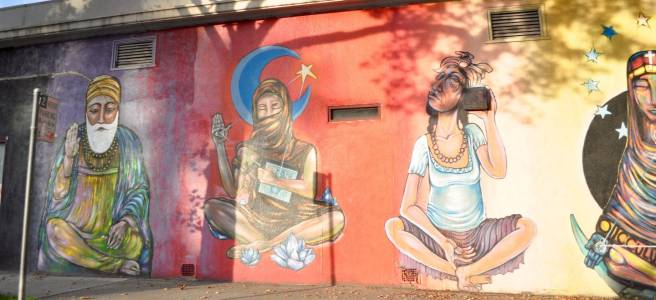
“I am the absolute” (Aham Brahmasmi) and “you are That” (Tatvamasi), are two of the foundational axioms (Maha-vakyas) of the Upanishads. “I am the way, the truth and the life”, says Jesus. “Look within your heart, for there you will find both Karim and Ram; all the men and women of the world are His living forms”, says Kabir.
Unlike the tribal God, this God of the seers belongs to all of us; He is us. This vision or version of God is conducive to an independent appreciation of him, needing no intermediation by any priests. He is also customizable according to our needs and preferences. We are free to go to any place of worship or to go nowhere at all. We are even free to say that there is no God1.
This approach to the Sacred is omnipresent in India. Here we worship anything, everything – rats, monkeys, wild boars, elephants, trees. Or we put a stone under a tree and start praying, singing with our friends whenever we feel like. We have created 33 million Gods and are still counting2!
People of all faiths visit the Golden temple in Punjab or the Sufi-Dargha in Ajmer, Rajasthan. In Kerala, before we visit Lord Ayyappan in Sabarimala, we have to visit and worship his (Muslim) friend Vavaru, and dance around the mosque in his name. This fluidity of our religiosity is a manifestation of a sensibility, of a semi-(un)conscious sense of oneness. The destruction of worshipping places in history had nothing much to do with people per se; these have almost always been part of rivalries and conquests of rulers and regimes or part of showing their power off.
Considering such rivalries, the God of the seer is radically different. As we equally embody Him, He is for equality. He is also for fraternity – to love one’s neighbour as oneself3.
If this God is emergent of non-dual understanding, what is the source of a tribal god that divides humans into us and them and unleashes violence? To understand that, first we need to understand the nature of tribalism itself.
The Psychology of a Tribal God
Tribalism can be defined as an absolute identification with and loyalty towards any relative value, be it family, caste, religion or nation. Usually, it is a package of interwoven identities that includes all of these. Needless to say, such identities are contextual or historical compared to the human identity which is natural and universal, that transcends time and clime. Such contextual identities are inevitable in our transactional realm of life; however, when they start masquerading as truth and meddle with our universality and dignity, they become absurd and dehumanizing. In other words, all relative notions are not necessarily troublesome, but need to be placed correctly in the overall scheme of things. The cart must be behind the horse.
The life of a human being is perpetually situated between these two sets of value or choice – the contextual and the universal. When one’s choice is led by the universal and the allied values consistently, it results in expansion, restfulness and innate joy. It is the abode of an ever deepening sense of oneness, and hence security, as well as equanimity4. On the other hand, a total identification with any relative value at once alienates us from the all-inclusive, from our deeper Self – the source of non-dual wisdom. Such a reductive relativism is the product of an ego-mind that does not go beyond (personal) memory or (collective) history. This vicious fixation of the ego is what is called Maya (nescience)5. The necessary counterpart of this exclusivity is otherness, with a potential for mistrust, fear and hatred.
If non-dual understanding is wholesome and enabling, alienation hollows us out and disempowers. It results in the insatiable need for power, many times derived from belittling and even abusing others. The othering ego-mind also lacks true Self-confidence and perpetually oscillate between feelings of inferiority and superiority.
As this fixation becomes an inter-generational and collective way of life (like caste or an ideology such as Hindutva), people lose touch with reality; they become delusional.
Other features and implications of the two Gods
If the God of Jesus, whose kingdom is within us, makes all of us sacred and worthy of reverence, the God of the Catholic Church makes us born sinners and worthy of lifelong humiliation and moral policing. The latter God has been a joint venture of a priestly class in connivance with the ruling regimes, ever since it had joined hands with the Roman empire.
For any violative system or regime to legitimize its very existence, first it needs to have a pseudo-knowledge system or ideology that takes away our inherent, supreme value from us. God needs to be separated from us, and that separation is the mother of all tyrannies. If the innate God makes each one of us a sovereign, its separation turns us into subjects. Sabbath (rituals, institutions) is not for man any more, rather he is someone to be sacrificed in the altar of duties and obligations. If he eats a particular food or does not stand up for a national anthem, he becomes lynch-worthy. He is nothing but an average man – a mere figure in the statistics.
The separation of our sovereign value penetrates into all aspects of our lives, mainly manifesting as the subjugation of our bodies. In the context of gender, it takes the form of patriarchy; controlling women’s bodies, their mobility, desires or free-will. In the Caste system, bodies of lower caste people become impure and even polluting for the upper caste. In the economic context, it manifests as the normalization of inequality, of bonded labor and the monopolization and exploitation of common bodies like rivers and mountains.
The inauguration of the Ram temple in Ayodhya, needs to be understood in the above detailed context of usurpation of our sovereign value and the subjugation of our lives in all realms – religious, regimental, patriarchal, casteist and economical. This event marks the unprecedented monopolization of the Sacred, making the Sacred subordinate to ego and its power-quest. It has been the consecration of Maya and the normalization and legitimization of avidya (ignorance).
The modern, global context of the Hindutva movement
Tribalistic, exclusionary movements are on the rise all over the world; they range from white supremacism to neo-colonialism. It is important to understand the growth of the Hindutva movement in India, in this larger context.
The modern world mainly owes its origins to what is popularly known as Modern Science, that is, Empirical Methodology. During the Enlightenment period in the West, modern science replaced the age-old wisdom traditions and religions to become the sole authority of knowledge and the way of knowing (methodology). With its studies and technological innovations in the fields of modern medicine, communication, transportation and military, it also became the practical lifeline of the world. However, with its reduction of all life into what is measurable, modern science has failed us miserably and catastrophically in understanding the essential value of ourselves or of life in general.
Modern market economy, where everything is a commodity to be sold or consumed, is a practical manifestation of this matter-of-factness in the domain of knowledge. The corollary of such a reductive modernity is the relativist postmodernity, where all values are relative, where truth is merely a belief, an opinion or a convention, where a human being is nothing more than his or her context and its conditionings. These value-void, relativist world-views and the confusing, disempowering, if not traumatizing, daily life they produce, are causing an avalanche of reactions across the world.
Movements like Hindutva are such reactions and contain a genuine, desperate attempt to make sense of the world meaningfully and to belong to an intimate community. Unfortunately, it is fundamentally corrupted by similar reduction and relativism with similar consequences.
The Hindutva cult originated among a section of people in pre-independence India, who had been blindly immersed in traditional ways of living. It is a (trauma) response of those people to British rule and their colonial knowledge paradigm, which uprooted them from such lives. The failure of the post-independence intelligentsia as well as the political-activist groups, who more or less subscribed to the same paradigm, in addressing the essential void at the core of modernity further aggravated the crisis. When this situation got coupled with the looming crises of the market economy, including mass impoverishment, displacement and never-ending uncertainty, things touched a breaking-point.
At the core of all the battle cries of Hindutva, there is a human-self yearning for dignity.
A Humanity at a cross-roads
Humanity is in an unprecedented historical situation; we have an opportunity to appreciate, study and even practically engage with cultures and communities from all over the world. We can see the self-same nature of our aspirations, thoughts and feelings in spite of all the geographical and historical differences. We produce things that would be intimately enjoyed by someone oceans apart. We watch videos of people from every nook and corner of the world, and smile and weep along with them.
Global issues like climate change further affirm our oneness by demonstrating the impact of even an individual’s action over the whole of humanity. Put differently, challenges like climate change that we face, cannot be mitigated by a few individuals or even countries; they demand a global consensus among us on how to live and thrive together. Necessarily, the foundation of such a consensus needs to be a whole-hearted, unwavering acceptance of our oneness; the embracing of one’s universality6.
We also have another choice at this crossroads; to reduce ourselves wholesale into relative identities and its othering insecurities and to (re)act from there. This is what is being done by our tribal chiefs or finance managers disguising themselves as world leaders. The disasters of that approach can be seen everywhere. One of the great opportunities inherent in this unprecedented historical situation is to learn from our past mistakes, to recognize the persistent patterns of our contractions and reactions which ruin our lives. If we boil down all such errors, it would come to the choice between two Gods – between an embodied, universal value and a reductive, relative, myth. Importantly, that choice needs to be understood not as a one time decision, but as an ongoing moment to moment process, since both possibilities are ever present within us. It also needs to be understood in living terms – in terms of relationships, parenting, vocation – as a different way of being.
If we are to use an instrument well, we need to know its purpose, scope as well as its limitations. It is the same with human life. Perhaps, it is time for some Self-education, as a matter of Self-respect.
- For instance, many Buddhist or Charvaka traditions have no reference to God.
↩︎ - Santhoshi Ma, is one of the recent additions to the pantheon of Goddesses in India. She had emerged into the public imagination with a hugely popular movie in her name made in 1975.
↩︎ - Narayana Guru (1856-1928), in this conversation with a social reformer who asked about religious rivalries masterfully reveals the common thread of values present in all religions: https://cloud.disroot.org/s/m9jKD6HsGojttQN . Similarly, in the article titled One Religion, Natraja Guru (1895 -1973) shows us the structural unity of all religions: https://mark.nl.tab.digital/s/P7WtYwAZHATDpJy
↩︎ - To the seer, all things have verily become the Self; what delusion, what sorrow, can there be for him who beholds that oneness? (Verse-7, Isa Upanishad).
↩︎ - He who sees (Self) as pluralistic, from death to death he goes. – Narayana Guru, Darsana-mala (A Garland of Visions), Chapter 2, Verse 10. From The Works of Narayana Guru,Translated by Vinaya Chaitanya, Pub: Harper Collins.
↩︎ - An open-source world-covenant written by the present writer can be found here: https://hobobodhi.substack.com/p/sovereignty-and-self-government-a
↩︎
 h o b o - b o d h i