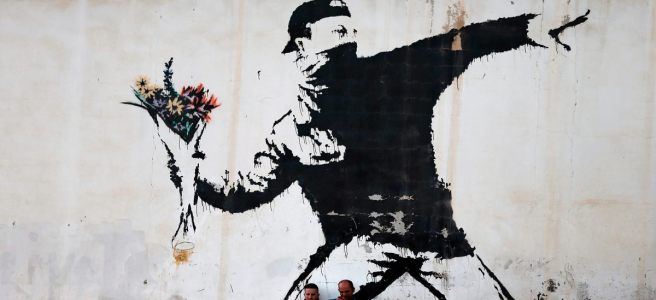
Image Courtesy: The Art Insider
(An Open-Source World-Covenant on Self-Rule, Based on Non-dual Understanding)
Prelude
We, as human beings, are facing an existential crisis that is global in nature. The crisis has many facets that range from personal feelings of loneliness, insecurity and gender discrimination, to degeneration of modern political institutions and degradation of the environment. The global nature of the crisis makes it impossible to be solved only by a few individuals or communities. A consensus across humanity is necessary to overcome the situation.
To make our consensus enduring, we need a foundational norm that remains relevant across time and space. It must be capable of integrating various communities while fully respecting the unique personality of each individual. Thus, the idea of the Self and its Sovereignty becomes the central theme of the present discourse.
The Self as a self-aware, self-reflective dynamism, is a constant in human life. It is the definitive verity that makes us human. It is the abode of all personal experiences or understandings and a necessary prerequisite for making community life possible. Therefore, if we could have a consensus on the basic nature and aspirations of the Self, it could serve as the normative vision for humanity, capable of integrating our diverse lives.
Importantly, since the matter in question is the nature of the Self, there is nothing to be found outside; the subject and object of contemplation is oneself. Besides, we don’t have to reinvent the wheel; it has been the quintessential concern of the poet-seers, philosophers or perennial wisdom tradition(s) from all over the world.
Still, any discussion regarding the human-self in our time has to consider two relatively recent intellectual approaches. One is modern science, the precursor of modernity, and the other one is postmodernism, both of which drastically transformed how we understand ourselves and make sense of life. Modern science or the empirical methodology – the dominant, official, knowledge system – studies the self matter-of-factly, typically considering the self as a consequence of a set of neural, chemical processes. On the other hand, post-modernist views consider the self more or less as a reflection of the social, cultural, class, contexts it happens to be; it highly favours relative, local, identities over the universal aspect(s) of the self.
The article starts by discussing the influence of these two inter-related streams of thought which deeply and almost always unconsciously shape our perceptions. The discussion ranges from Darwin’s theory of evolution to neo-liberal economic views, while analyzing how modern science supplies the logic for the self-injurious ways of modern living.
The second part of the article attempts to enunciate the universal nature of the Self or the innate axioms belonging to the same, in a systematic manner known to perennial traditions. The final part explores the possible reorientation(s) of the practical aspects of our lives in view of this wisdom of the Self.
A detailed discussion of all these topics could extend to hundreds of pages. But the intention of the present work is to give a concise introduction to the most important aspects we need to explore in the context of the personal or global crisis. To avoid the tediousness of a lengthy essay, to make it simpler and more accessible, a question-answer format is also chosen.
With the hope that the article would inspire you to delve deeper into the subjects discussed, I hand it over to you, beloved reader.
Sovereignty
What does Sovereignty mean?
The word Sovereignty has many layers of meaning. It could refer to the practical autonomy and self-sufficiency of a person or community. It could mean the absolute authority of a (governing) body over itself. As understood by various wisdom traditions, it could also refer to a state of Self-contentment – a freedom from fear or want – resulting from Self-understanding1.
In the modern era, the term is predominantly used in the context of political philosophy, especially to denote the supreme authority of the modern political establishment called Nation-State. The sovereignty of the nation-state has both external and internal dimensions. Externally, it typically implies the territorial integrity of a nation. Internally, it commonly refers to authority over a population, monopoly over force, control over natural resources, etc., within its territory.
What is the basis of the nation-state’s sovereignty? How is it legitimate for the nation-state to claim such sovereignty?
Principally speaking, we could say that a modern, democratic nation-state derives its sovereignty from its constitution. The constitution, in turn, finds its authority from its intention to protect certain basic rights of the citizens, such as their right to life, from violation.
In 1948, the United Nations adopted the Universal Declaration of Human Rights, which attempted to integrate normative notions of human rights with various ideas of exclusive citizenship. It was gradually ratified by most of its member nations and begins by stating:
Whereas the recognition of the inherent dignity and of the equal and inalienable rights of all members of the human family is the foundation of freedom, justice and peace in the world,
Whereas disregard and contempt for human rights have resulted in barbarous acts which have outraged the conscience of mankind, and the advent of a world in which human beings shall enjoy the freedom of speech and belief and freedom from fear and want has been proclaimed as the highest aspiration of the common people,
Whereas it is essential, if man is not to be compelled to have recourse against tyranny and oppression, that human rights should be protected by the rule of law…
That is to say, in theory, the inherent sovereign value of a human being is the foundational idea of modern democratic ideals. A democratic constitution derives its legitimacy from vowing to protect this fundamental value or dignity and consequent inalienable rights from possible violations through the establishment of the rule of law. The (modern) state is the embodiment of the constitution, with the government being the instrument serving that purpose.
In other words, the modern democratic nation-state obtains its legitimacy and sovereignty as the representative of the common good or the common will, verified by periodic, independent voting based on universal franchise.
How is a common will or democratic community formed?
A democratic community is formed when a sovereign person consciously recognizes that their inherent, inalienable value is a common principle, that it is an essential truth of every (human) existence2. This then also forms the basis of equality, that is, the idea that all humans are equal in value, irrespective of gender, class and religion as well as the idea of fraternity.
Since human beings are communal beings by nature, and have to live together to survive, not to speak of our mutual emotional-intellectual needs, sovereigns enter into a common agreement (constitution). Its purpose is to orient their daily community life while protecting the dignity of every member of the community.
What then is the relationship between the sovereign, the community, and the state?
Each human being, by virtue of having an innate value, is a sovereign and has the inalienable right to live as they please. As a sovereign recognizes one’s mutuality and inter-dependency with fellow sovereigns, a community emerges. The state represents the common will of the community to organize its life according to the principles of liberty, equality and fraternity. The community or the state can interfere in the life of a sovereign individual only if they restrict the liberty of fellow beings or (intentionally) engages in violence towards them. Otherwise, a sovereign is free to exercise their will as they want. That is to say, to protect one’s liberty, one needs to practice non-violence only. All other obligations of the sovereign to the community are only voluntary in nature.
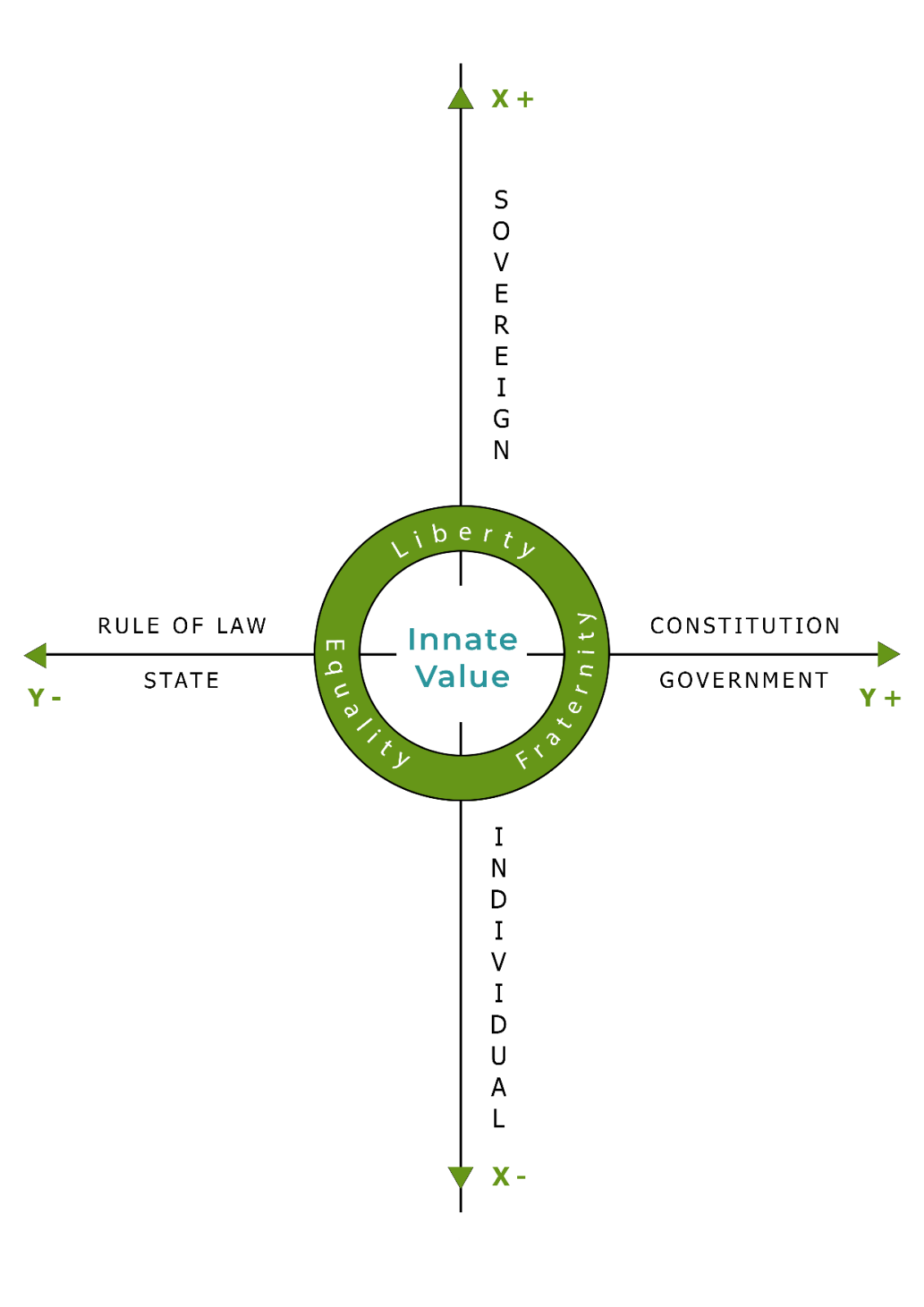
(The vertical axis represents what is absolute or necessary. The horizontal axis represents the relative or functional)
Given such a substantial philosophical basis, why is it that in reality, many individuals and communities all over the world experience the modern nation-state as a notoriously militant, repressive, and ecologically short-sighted entity? It is as if the very institution we created to secure the common good is actively destroying it day by day!
There are historical and structural reasons that make the (nation) state tyrannical, which we shall discuss later. More generally, however, this self-contradiction of the nation-state is not a lone phenomenon of that particular institution but the general character of all major fields of modernity, be it modern medicine, education and technology. For example, the so-called Green-revolution which introduced chemical farming while claiming that it would produce food for all, has, in fact, poisoned the entire biosphere, sparing not even breast milk. We could trace back such self-contradictions of modernity as essentially belonging to Empirical Methodology, popularly known as Modern Science.
Modern Science – The Dominant Knowledge System
What is the relationship between modernity and modern science? How are the modern nation-state and science related?
Modern science is the only system of knowledge considered authentic by modern education and institutions more generally. As the dominant knowledge system, it has sidelined other approaches to knowledge including indigenous and religious ones. Modern science could be described as the original driving force behind modernity enabling it to reign supreme by bringing about a paradigm shift in technology and resource usage. Inventions ranging from the steam-engine to the internet and artificial intelligence, created and continue to sustain the infrastructure underpinning all of modernity, including the military, communication and transportation.
Modern science is the yardstick of our time against which every other approach to knowledge or life is measured to be considered legitimate. So the contradiction of the modern state must be understood in the overarching modern scientific context.
Please elaborate…
Let us explore further the political philosophy we have been discussing. As we have seen, the foundational idea of modern political philosophy is the innate value of a human being. But what if we question this axiom? Do we really have an innate value? Do we, or our lives, have any real meaning or significance? Could this axiom not be a mere social construct to make a harmonious collective life possible? Is it perhaps a collective delusion necessitated by nature for the survival of the species?
How would modern science, as the only authentic knowledge system of modernity, answer such questions?
The fact is that modern science, has absolutely nothing to say either about the innate value of human existence, or about value itself. At best, it may be able to describe the neural-physical processes of the brain that (it thinks) acts as the basis of our sense of self-worth. In other words, as a methodology that insists on objective observation, measurement and experimentation, modern science is inherently incapable of containing the idea of value of a human being or of the existence more generally. Is it not bewildering that the only authentic knowledge system in our time is in total disconnection with the central assumption of our human rights thought and democratic institutions? Could not that explain, to a great extent, the self-injurious approaches, technologies and policies perpetuated by our scientists and politicians in the name of the common good?
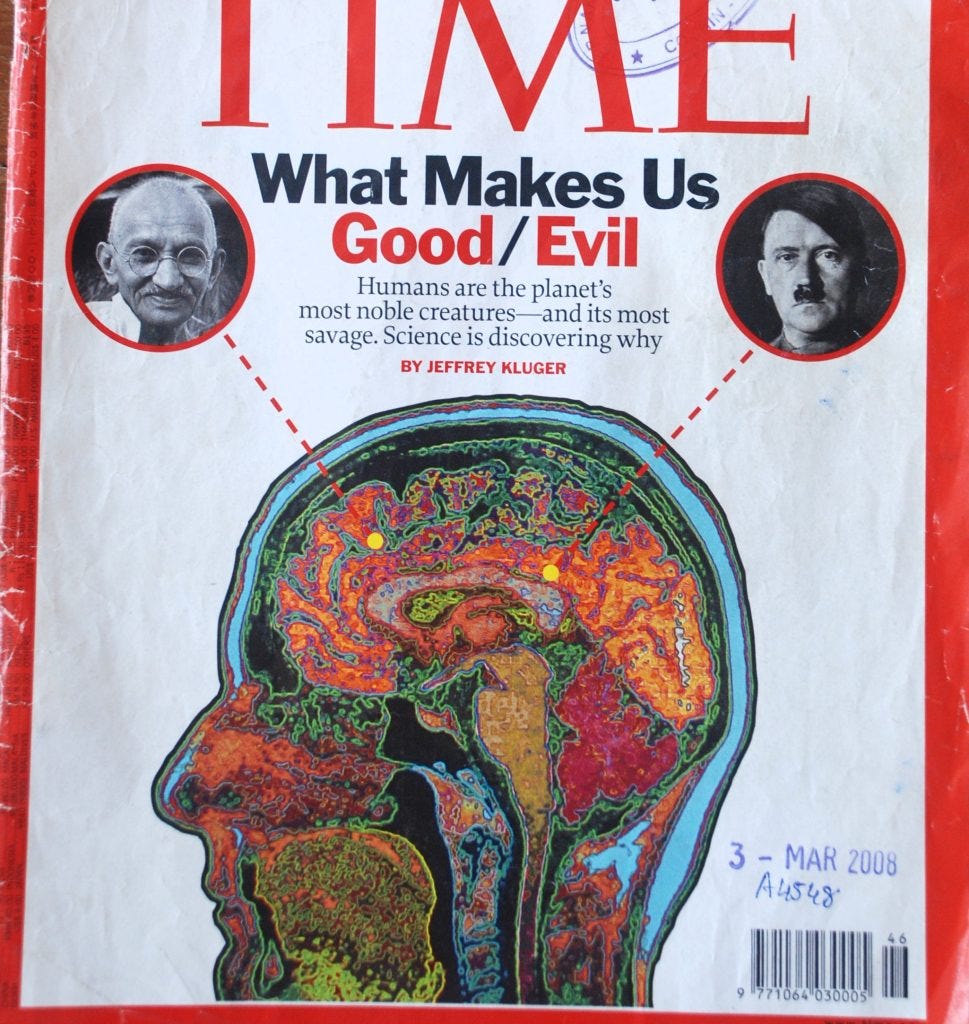
Does this mean that the contradictions of modernity originate from modern science itself?
We could say so. Any system of knowledge worth the name must address three aspects of knowledge in an integral manner. These are: a) Epistemology b) Methodology and c) Axiology. In the context of science, we can call it concisely the Philosophy of Science.
Let us consider the aspect of Axiology (the science of values), first. A knowledge system or a science must have a clear understanding of value, in general, to justify its own value. Without such an understanding, we cannot think of any value for the knowledge a science produces or for the science itself. It is true that a science without a philosophical or axiological element could still have practical, utilitarian, relevance; but would be majorly susceptible to shortsightedness and viciousness. Claiming to be a (valuable) science without an axiology is one of the main self-contradictions of modern science; it is self-negating. As the official knowledge system of modernity, the commissions, omissions and the contradictions of modern science penetrate, influence and (de)form all other aspects of knowledge.
What are the implications of this contradiction?
From a humanitarian perspective, when a value-ignorant science reigns supreme as the only authentic way of knowing, all notions of value, including the notion of innate (human) value, become fictional concepts, arbitrarily and conveniently assumed to orient daily community life. Any claims of basic human rights become effectively hollowed out; making those rights constantly vulnerable to the whims and wills of the powerful – as is evident all around us.
Innate value is the supposed universal that holds true for all. When this axiom is ignored, implicitly or explicitly, we are negating our commonality. Common-sense or the sense of community cannot survive in such a situation. Thus the community becomes a bunch of individuals mainly pursuing their exclusive, private interests; interpersonal relations degenerate into being utilitarian. When someone gets individuated thus, identifying with one’s unique body alone, the world becomes a definite other as a consequence. At the same time, since that individual body is always susceptible to illness, accidents and death, insecurity or fear becomes a constant in an individual’s life. This alienated and insecure individual is instinctively prone to safeguard oneself from the other and even dominate and control the other, so that a relatively secure situation can be maintained. Collectively, the result is a shortsighted community dedicated to self-preservation. Such a community necessarily produces a State that sustains itself with the promise of protection from the other; rendering a militant State natural and normal. Similarly, modern market economy promises liberation from the void, resulting from alienation, through the incessant consumption of materials. All these factors together define, normalize, envision, bring out and perpetuate a human being who is solitary, poor, nasty, brutish and short3.
How could such a reductive, utilitarian approach to life not only be legitimate but indeed the only possible way of life for the majority of people?

To repeat, the principal reason is the establishment of a value-void science as the final authority of knowledge or life. The mere touch of that science objectifies and materializes everything. It turns the universe into an aggregation of matter, gases and liquids, and human beings into mere collections of cells, hormones and secretions. The human self, the abode of all value experiences, is altogether left out by it. It is this materialization of life or nature by modern science that is reflected in the commodification of life brought about by the monetary economy. Modern science is the supplier of the logic that legitimizes the very existence of such an economy. The ongoing spree of technology, ranging from genetic engineering to space exploration, with commercial profiteering as the main goal, is a similar offshoot of the same anomaly. The all-pervading discourse of development (of the economy) that typically avoids any substantive discussion concerning the meaning or purpose of the process, in fact is a demonstration of the evasive orientation of the contemporary knowledge system on essential matters.
It is also striking to see how the mainstream media characteristically stresses the relative nothingness of (human) life in general while it lauds the exploration of the universe by modern science. That narrative could be sensible and even logical only against the backdrop of modern science that effectively reduces the meaning of human existence to nothingness.
Is the contradiction of empiricism only related to values?
Certainly not. Consider the epistemology of empiricism. Epistemology must enunciate a theory of knowledge, that is, what is knowledge or what is the purpose of knowledge. Since for a science there can be nothing outside of knowledge, it has to establish first what it means by knowledge. It is a philosophical verity a science must have, to legitimize its own existence.
Yet modern science does not refer to the truth of knowledge or the knowing human being; it contents itself as just the enquiry for it or as the study of specific fields of knowledge. It only endeavours to discover the truth (of knowledge or of us), which is here and now, in an unpredictable future and even that finding is considered only probable.
This truthlessness of modern science renders everything, not just science, but human beings, the whole existence itself, hollow. There cannot be any true, everlasting, meaning to anything; instead, things can have only transactional and transient meanings arising out of daily life necessities, until that golden day of truth arising out of that ultimate scientific experiment! To see the impact of this approach on core subjects, one has to look into modern psychology alone: if we are to understand the abnormal, we need to have an idea of the normal. But what is the normal today? The norm is a conformist who internalizes the reductive outlook of the system and works for it lifelong. Kicking out the truth into an indefinite future also pervades our daily lives. In modern education systems, students are told to tolerate all sorts of intimidations and restrictions for their benefit at some point in the future. One of the fundamental, if implicit, work ethics of modernity is that, You are not supposed to be happy here and now. Life is a struggle (read: experimentation). Now you should work, so that you can be happy in the future. Similar is the case with the so-called development process; we are supposed to wait patiently without complaining for that ultra developed age to come, even while we are literally suffocating to death due to the aggregate pollution brought about by the process!
The negation of the living truth sharply limits, shapes and interprets how we personally understand or experience time-space. It is not unlike religious priests postponing heaven to another world, even when wise ones have unmistakably declared time and again that it is here and now4. This postponement of the truth (or of sovereign value) is what always legitimizes and normalizes the existence of hegemonic institutions and their command over human beings.
Moreover, when modern scientists act like they are the ones who would eventually figure out the whole truth for the first time in history, they essentially trivialize the lives of human beings who have lived before.
Can we then say that as a knowledge system, modern science is self-negating?
Yes. A knowledge system ignorant of the truth of knowledge (epistemology), is a system that is self-ignorant or self-negating. In other words, since knowledge is the defining verity of a human being, when a human being is ignorant of the truth of the knowledge, he or she is not self-aware. This self-negation in the domain of knowledge is what manifesting as our suicidal lifestyle in general.
A (Very) Brief History of Modern Science
To begin with, how did modern science come to have such an erroneous, unphilosophical, orientation?
All knowledge is inseparable from the knower, the human being. We call something knowledge when it is sensible or affective to a human being; they are the converging, integral point of all knowledge. Therefore, until the modern era, philosophy that contemplates the purpose or meaning of human existence, had been considered as the foundation of all specialized fields of knowledge. Likewise, since the essential reality of human existence cannot be different from the reality of the whole existence, that is, the universe, cosmological enquiries into the nature of the universe, the relationship between the human being and the universe or the significance of a human being in the universe, were understood as philosophical matters. That is to say, psychology and cosmology, the microcosm and the macrocosm, were always understood dialectically or as the necessary counterparts of the same reality. Subjects like astrology, biology and alchemy (chemistry) conducted their research within this overarching, dialectical framework provided by philosophy.
In Europe, after the (Catholic) church ascended to dominance following the 5th century (CE), philosophy was replaced by the theology of the Church, which nevertheless retained Greek-Roman philosophical influences. During that period, many of the researchers of (empirical) sciences were Catholic priests and their studies were often motivated by religion.
Later, during the late Middle Ages, many findings and conclusions of empirical studies that had aligned with the worldview of the Church, were proved wrong by new discoveries and reformulations. For instance, the earth had been considered to be the center of the universe according to the theology of the time, but Nicolas Copernicus (1473-1543) proved that this was wrong, empirically.
The response of the Church to this and similar explorations and studies was dogmatic, and it tried to suppress such findings through threats and punishments. The Church burned alive Giordano Bruno (1548-1600) who had challenged the orthodox cosmology, and intimidated many like Galileo Galilei (1564-1642). This situation led to the gradual separation of theology or the philosophy of the time from science, that is, fields like astronomy and medicine. The scientists of the time did not dare to revalue and restate the epistemology and axiology of theology, but went ahead with empirical methodology alone for furthering their studies. They most likely expected to soon discover the truth empirically, and that their findings would initiate the required revaluing. But eventually, the overarching power of the Church got diminished and the empirical methodology positioned itself center stage, especially during the later Age of Enlightenment. Empiricism revalued and restated epistemology and consequently axiology in its own image; reducing all knowledge or experiences into what is measurable. The scientific community’s experience of religious oppression and the lack of freedom of thought during the medieval period likely encouraged them to assert the empirical approach to knowledge over the non-empirical, philosophical approaches. Thus, modern science established itself with an unphilosophical orientation.
It seems, there is a general scepticism in the modern scientific tradition about anything that speaks with certitude about reality. Having experienced the dogmatic assertion that insisted on faith at the expense of reason, and experiencing its dire effects, we could say that there was a reactionary suspicion by scientists against anything that conceives truth in an apodictic manner – which the scientific tradition retains to this day.
The Postmodern Turn
In the postmodern era, truth is a very contentious word. The perspectives that could be called postmodernist, generally take a position against any universalized version of truth that transcends time and space. Here, truth is contextual, individualistic or an amalgamation of various perspectives. There is no truth, but truths!
Is not the idea of One Truth the single greatest ingredient for a dictatorial regime?
We cannot stop discussing truth, citing the abuses that have taken place in its name, just as we cannot stop discussing community life, citing the possible errors in leading one. It would also be self-contradictory to insist on there being no truth as the truth!
When we say truth, we are not referring to individual preferences, views or actions which are necessarily divergent, but the all inclusive Existent. It is the Beingness of everything or the Being in all beings. If we say, there are many truths, then there cannot be any certitude about anything, including about the value of (human) life. Every assumption could be contrarily disputed and negated including the very statement there are many truths. In this sense, many truths means no truth at all. In such a no-truth situation, all perspectives would be equally valid or invalid; the idea of the better would be null and void. It is a situation of absurdity and chaos.
When the oneness of Truth or the first principle that is true of everything is negated, then the assumption of commonality is impossible. The term we used in an inclusive manner would be more or less nonsensical. In fact, such post-modernist arguments originate from modern science itself.
But these schools of thought seem to be in rival camps at present; many postmodernists even question the very relevance of modern science.
For a philosophy or science that systematically studies principles that are universal or true of everything, it is impossible to negate the oneness of the real. In other words, science seeks to understand the common; if the commonality is negated, there cannot be a thing such as science.
But as we have seen, the epistemology of modern science that postpones truth, the common, to an indefinite future essentially makes the common insubstantial and non-sensible; it effectively disintegrates and individuates everything. That is, when the all-inclusive Absolute is negated, relative identities become absolute. Hence, the disproportionate postmodern assertion of various contextual identities. The ongoing endless specialization of various areas of study, lacking a comprehensive view of the whole (modern medicine for instance), can be cited as an example of the relative becoming the absolute. In this sense, postmodernism is just a more honest and blunt version of modern science.
Revaluing Modern Science
The existential crisis discussed at the beginning calls for a common, global, consensus. So, how could we move from the disarrayed present narrative to an integral one?
The disintegration of the common negatively affects the communication and consensus among us. In a situation wherein only private truths exist, it becomes more or less irrelevant even to listen to someone else; communion would be missing. To revaluate the situation, we need to first look at one of the main blind spots of modern science in relation to an integral approach.
Human understanding, naturally, has a transactional dimension – the relative and objective world of the many or of various names and forms. It also has another dimension that is subjective and aesthetical which can abstract and generalize the actual plurality to touch the Singular, the Absolute. Therefore, throughout the history of various wisdom traditions, there has been a consensus about the need to have a dialectical approach5 for conceiving both these aspects of knowledge in an integral manner.
The transactional aspect of knowledge is the domain of the measurables, where an empirical approach can be used to gather functional, utilitarian information. In non-modern knowledge traditions there is a clear recognition that this positive-empirical approach is inherently incapable of realizing the Absolute, the Immeasurable, the Aesthetic. To realize this subjective aspect of knowledge, there is another approach known as the negative way6 or the nivrtti marga (the path of withdrawal) which does not intend to name or measure, instead taking the approach of being negatively assertive, ‘not this, not this’ (neti neti) – rejecting piecemeal, object-oriented knowledge, in view of a holistic vision emerging by itself.
The term Vedanta7, which means beyond knowledge or end of knowledge, exemplify this approach unmistakably. The icons of Buddhas, spread all over the world, sitting with half closed eyes – indicating disinterest in relative knowledge, holding jnana-mudra (gesture of wisdom), similarly reveals the perennial way.
This negative way of understanding is guided by the a priori approach, wherein conclusions pertaining to knowledge are not derived from actual observation or experimentation (a posteriori approach), but from introspection and innate logic. Reality being One is such a conclusion, which does not call for any experimentation for verification. Unlike such knowledge traditions, however, modern science one-sidedly insists on the empirical, the objective, based on experimental verification.
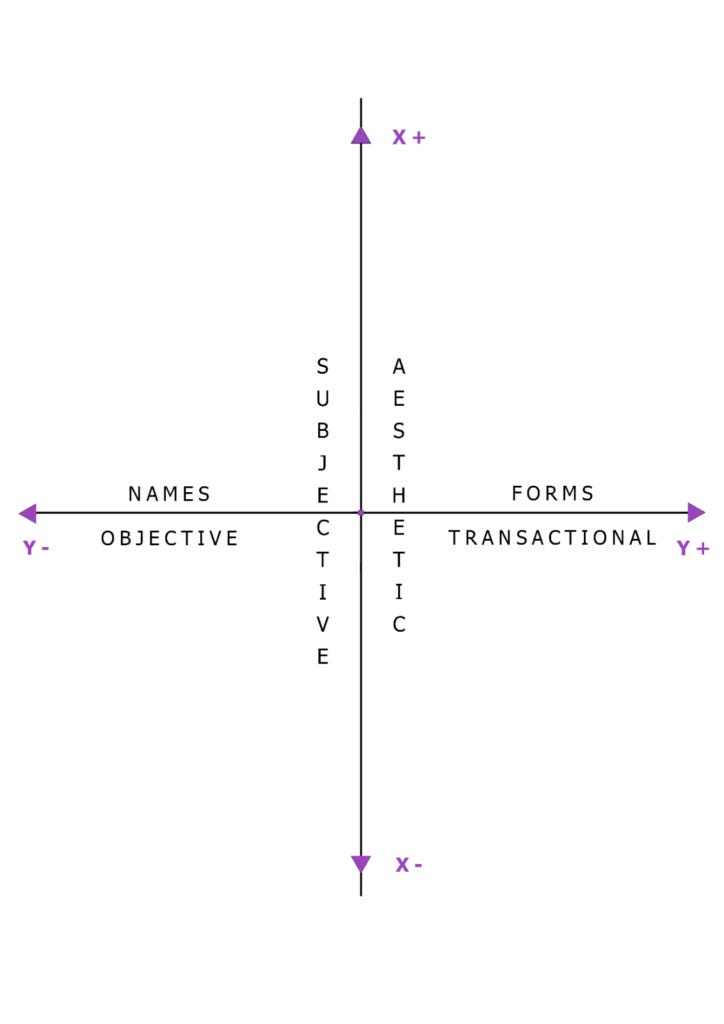
(Vertical axis represents the fundamental and the horizontal axis represents the incidental)
Consider, for example, the Big Bang theory of modern science. It states that the universe originated from an all-encompassing (cosmological) Singularity. But science is preoccupied with the relative, manifested aspect of the Singularity, i.e. the universe, while marginalizing the non-relative aspect of the universe, i.e. the Singularity. Vertically viewed – from the perspective of the Singularity that has nothing outside of it – the entire creation-dissolution of the universe is happening within itself, integrally. But modern science seems to be fixated on the details of the Big Bang, much like how children get enamoured by fireworks.
It is not that the empirical is irrelevant, but such a methodology needs to be understood integrally with the innate axioms of knowledge derivable from the a priori approach. The various fields of science are themselves the primary victims of the absence of such an integral first principle; they simply get lost in the pursuit of endless specialization. Further, a methodology-driven science without any overall sense of meaning, in practice translates into a technology-driven world. This is how science has reduced itself to a tool of technocracy. If modern science is a religion, empirical methodology is its God, which it trusts to solve every single problem!
Unitive Philosophy or Unitive Science
Can the innate axioms of knowledge be elaborated?
Both the oneness of Being and the innate value of Being are foundational axioms. These primary axioms are unquestionable, for if disputed, there cannot be any general, systematic and meaningful understanding. As we have already seen, if we negate the Oneness or the Universal, we could only have relative, specific and functional knowledge. Similar is the consequence of the negation of the innate value; all values become relative and utilitarian, arbitrarily and conventionally assumed.
If we accept these axioms, we can deduce other verities of knowledge: since the Being is all-inclusive that has nothing outside of it, its value is necessarily absolute. From a human being’s perspective this implies, I am the Absolute, the Sovereign. The maxims of the Upanishads such as, ‘I am the Absolute’ (Aham Brahmasmi), or ‘This Self is the Absolute’ (Ayam Atma Brahma), and ‘You are That’ (Tattvam Asi), as well as Jesus’ saying: ‘I am the Way, the Truth and the Life,’ or ‘I am the truth’ (Ana L-haqq) as declared by Mansur Al-Hallaj, unmistakably confirm this axiom. Chief Seattle, too, asserts our oneness when he says that, ‘We are part of the Earth and it is part of us. The perfumed flowers are our sisters, the deer, the horse, the great eagle, these are our brothers. The rocky crests, the juices in the meadows, the body heat of the pony and the man, all belong to the same family.’
It is an objectively verifiable fact that such a non-dual axiom has been discovered, realized and proclaimed innumerable times across time and space. The appeal of their words, which lived on across generations and geographies, is also beyond dispute.
One who knows one-self knows the Absolute, and one who knows the Absolute is the Absolute itself, are similar verities exalted by perennial wisdom tradition(s). Man, Know Thyself was the maxim inscribed in the forecourt of the ancient Greek wisdom temple of Delphi. Man is the measure of all things said Protagoras (490-420 BC), a Greek philosopher.
Succinctly put, the ultimate conclusion of a philosophy or science worth the name is not even that You are Free, but that You are Freedom itself. Viewed thus, contemplation is a process through which Freedom becomes conscious of its freedom, through itself and for itself. It is a grand process of Self-exploration or Self-appreciation (Atma-rati).8
How do we go about integrating these innate axioms with modern science?
Understanding the innate axioms allow us to see how the dialectical counterparts at all levels, like the Self and the Universe or the psychological and the cosmological, are participating in a complementary, compensatory and reciprocal process that culminates in a cancellation or union of both, as we could also see in the man-woman relationship.
Similarly, the negative (a priori or metaphysical) aspect of knowledge and the positive (a posteriori or physical) aspect of knowledge are best understood as necessary counterparts of the total knowledge situation called life. These counterparts have a natural one-to-one correspondence and can verify and confirm each other to arrive at an absolute certitude, just as algebra and geometry can verify each other and confirm a central verity. Maybe we could call this integral approach to knowledge Unitive Philosophy or Unitive Science.
History and Historiography
But our history seems to tell a story of contradictions and violence between philosophy, science and religion, rather than of integral union.
That may seem true, and to understand why, we must examine the history of historiography itself. Modern historiography, which originated in Europe and has been made popular through the curricula of schools and colleges worldwide, more or less projects the history of humanity as a series of perpetual struggles and acts of violence for survival or for domination. A key driving force behind such a narrative is that traditionally historians have been appointed or endorsed by rulers. They tend to document and comment on events and exceptions, like wars, rather than the rule – the daily peaceful co-existence of communities. They then serialize these events into the story of an era, or worse, the story of humankind. This traditionally dominant, official historiography, meanwhile, also normalizes and legitimizes the existence and the violence of ruling regimes which produced them. In the present scenario, this narrative of history is further twisted to make violence appear inevitable, and therefore something to be tolerated and even encouraged. Basically, the system produces historiography in its own image. In other words, historians see what they are looking for. The purpose of their study of history or life in general generates the historiography they adhere to. This is not to say that everything was rosy in the past; nevertheless, there is a clear bias towards recording exceptions and exaggerating the negative.
If we look closely, we can see many facets to this exaggeration of the negative. According to popular Western historical narrative, spirituality is something that emerged out of fear of natural elements such as thunder and fire, as if it could not have risen out of any other feeling like a sense of beauty and awe! We can see how this lopsided view conveniently dovetails with the rest of mainstream Western culture: Institutionalized spirituality (in Europe) stresses the notion of original sin while the dominant (neo) liberal economics assumes that the human being is a selfish maximiser. Similarly, the fundamental postulate of modern economics is the assumption of scarcity – projecting a sense of deficiency. The habit of understanding life as a struggle was further accentuated by a negative conception of the Darwinian theory of evolution, in which the struggle for existence and survival of the fittest are central references. Such a negative, fear-based orientation of our understanding of the past, naturally extends to our comprehension of the present and the future, and is being continually reinforced through the propaganda of state and market economy in order to serve their own ends. This conglomeration of reductive projections makes the collective past of various communities appear terrible and nothing to be inspired by. It results in self-perpetuating confirmation bias9 leaving a society cut off from its roots, infused with pessimism and hopelessness about life in general.
For an exploitative system, it is necessary to establish weakness or violence as the first element of human nature and to normalize violence as the natural way of life. Primarily, this legitimizes the system’s own violent existence while establishing the necessity of the same system as the protector against violence from the other.
So, what is being suggested? To have a balanced outlook?
Yes. Our popular history is mostly confined to a minuscule four to five thousand years which amount to only a fraction of human existence, and even that with major limitations. Contrary to the image created by the above mentioned historiography, we don’t have a comprehensive view about the intellectual-emotional or subjective life of those human beings with their history of 300,000 years or more (to go with modern style of time-lining). Perhaps a close study of indigenous, pre-modern communities and their traditions may enable us to develop a more balanced perspective of our shared history. If we care to look, we would see immense sacrifices made out of love and care, such as the passionate nurturing of children by elders, throughout our daily lives.
Our collective past needs to be understood dialectically without any exaggeration of either positive or negative aspects.
Self-Government
We were talking about the need for a global consensus and we also saw that modern constitutions are common covenants with good intentions. Is it possible to convert these covenants and thereby the institutions that govern in their name into something truly liberating?
There is a paradox.
The common inspirations or goals of modern democratic constitutions can be traced to the triad of ideals – Liberty, Equality and Fraternity. In view of a general human well-being, these principles are indeed laudable. These constitutions envision the nation-state as the administrative institution to orient our daily community life based on those ideals. In other words, modern constitutions are detailed by keeping this institutional structure as a constant.
But if we were to trace the actual, historical evolution of the modern nation-state from previous power structures and institutions, we would clearly see that the modern state emerged and developed in Europe in lockstep with Mercantilism and later with the Industrial Revolution that began in England during the 18th century and gradually spread all over the world. Unlike the pre-modern regimes that had been sustained by farming, the modern nation-state and its apparatus like the military, communication, transportation etc., were totally dependent on the industrial mode of production. That is, without industrial production and the consequent market economy, the nation-state as we know it today would not have emerged.
Market economy, in turn, is something that primarily exists for private profit and has scant regard for the common good. It unilaterally aims for ever growing (private) profits through ever growing material production and transactions. Such an idea and attempt towards infinite material growth and accumulation of private wealth on a planet with finite resources is inherently violent and destructive. It also results in the unequal appropriation of natural resources, the commonwealth of humanity, by a few. Needless to say, such a market economy is sustained by competition and, undergirded by the strategy of divide and rule.
The question thus is how such an administrative institution that totally depends on an inherently violent production system for its survival can secure the universal ideals of liberty, equality and fraternity. It is, in fact, impossible. More to the point, the state now essentially functions as the military wing of the economy, existing primarily to provide security for, and to further the interests of, private capital. To illustrate this, we only need to look at one of the biggest and most urgent crises we are facing: climate change. It is clear that the intertwined institutional interests of the state and the market are the greatest impediments for solutions to the climate change crisis.

Image Courtesy: Jeff Widener (Tank Man)
In modern times, every single human being is born as a citizen of one or the other nation-state, without exception and without choice. There is indeed no place for humans to live outside of this system, and people are forced to swallow the state’s propaganda that it is the best system possible. Certainly, this violates one of the basic principles of democracy – a person’s free will or choice. It is not unlike the situation where children are initiated into one or the other religion in their earliest years without any informed consent. If we do not have a choice to opt-out from a system, the system indeed is dictatorial and hegemonic. Nation states’ claim that the common good cannot be realized without them, is similar to the Catholic Church’s claim that God cannot be realized without it.
But the nation-state and the market economy play an overwhelming and very concrete role in our daily lives. How could we practically go beyond or dismantle such huge establishments in a globalized world?
As we have seen, though our modern constitutional ideals are worthy, the people who created such covenants mixed-up such values with untenable structures like nation-state. This lack of practical wisdom is the necessary result of their paradigmatic ignorance or indeterminism regarding their own foundational idea of innate human value. So, there is a need to revalue and re-state our common consensus in view of a Unitive Philosophy that absolutely affirms the value, freedom and sovereignty of human beings and the equality among them. When it is revalued thus, the only norm that a human being needs to keep in mind to secure their sovereignty is that of non-violence. The community or the state has no right to interfere with a sovereign unless they restrict the liberty of fellow humans or is (intentionally) violent to them. That is, a world citizen who lives unitively has to be understood as a self-contained, self-ruling, government.
In other words, such a Unitive Philosophy which is at once universal and personal is the consensus we need to have.
Self-Government? Can this concept be elaborated?
Self-Government could be understood as a self-governing, independent sovereign, as well as an open source world vision in which a self-inspired sovereign, participates independently and/or collectively from wherever they happen to be.
The greatest strength of such a unitive-consensus is that it does away with the need of institutional hegemonic force to ensure its compliance by members of humanity. Everyone wants to live freely and no one wants to be violated. Or, as the saying goes, In everything, treat people the same way you want them to treat you, for this sums up the Law and the Prophets10. A law cannot be simpler and anyone could verify it and understand how it ensures their happiness – the innate, fundamental urge of a human being – as well as adding to the common good.
If one chooses to deviate from the unitive consensus, one could only do so at one’s own risk, since such an exclusive, dualistic way of life would necessarily alienate one from the One, the wholesome, and thus would necessarily affect one’s innate joy negatively. When one chooses to do so, it is not like one might experience its negative effects only at some other time, as religions seem to suggest, but that exclusive intention or the act itself is the regression for one.
Put differently, the being we call human is an embodiment of meaning or value. It is a self-reflective, self-appreciative being driven by the fundamental urge for self-care or self-happiness. It is for self-happiness alone that a human being does everything. But when this self is understood exclusively, everything becomes self-contradictory; when it is realized inclusively, everything is self-contented. To solve all the crises of humanity, we need only to let the natural self-care be inclusive.
Further, the Self is the necessary existent and the common that makes the community possible. Everything that the community is, is emergent of the Self only. When the (true) nature of the Self is understood, the (true) purpose of the community and its function will be understood at once.
But still, what is the practical aspect of the revaluing? What about the state or the economy with their vested interests, which might actively disrupt such a consensus and the associations arising from it?
All systems are run by human beings, and wisdom can be transformative for anyone at any time. It must be clearly understood that the present crisis and its solution are not primarily ecological, political or economic, but educational. Therefore, no one should be considered to be outside its scope. To handle the situation in terms of us versus them, that very dualism which is inherently violent, would ruin everything. It would, in fact, be ensuring that the dualism, the fundamental flaw of the present paradigm, would continue in some other form. Similarly, it is important not to think in terms of destruction of the present system and the establishment of something new. Sudden, huge disruptions would provoke self-preservation instincts of too many of us, making us desperately cling to and thus recreate what had been familiar and predictable. Insecure, chaotic situations could also unleash personal or collective traumas and patterns that are violative.11
An educational approach builds a system ground up by making inclusive values self-evident, hence authentic and legitimate. Consequently, many other things would lose their locus standi for becoming evidently illegitimate. We have to let our emerging sensibilities and needs naturally form, reform and deform organizations without fixing any particular form as final.
This is not to say that we should not discuss the practicalities of the transformation process.
From the perspective of the citizen, the fundamental purpose and duty of the state (or any such system) is to protect their right to life. It is thus perfectly rightful to withdraw one’s consent and affiliation from any contract or institution that fails to deliver on this duty, not to mention if it actively endangers one’s very existence. That is, the right to opt-out from a contract that imperils one’s life is part of one’s right to life, and is also part of another fundamental right of a sovereign, the right to be left alone.
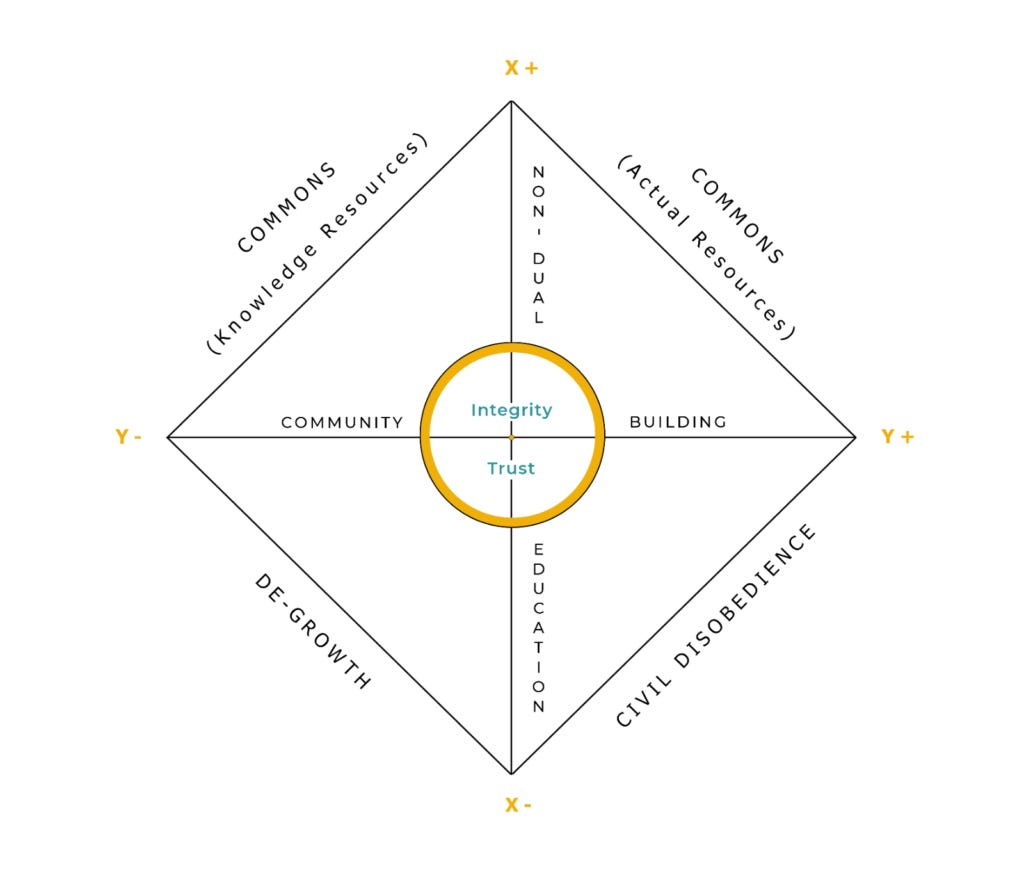
The practical process of this withdrawal could have many facets. The state and the economy envision and propagate a lifestyle that necessitates their existence. In other words, if we are to envision our lifestyles as propagated by the present system, we would consequently need that very system to maintain them. It is thus necessary to re-imagine our lives thoroughly. As nation-states supposedly represent the common good, it is the trustee of natural resources i.e. everything except private property including forests and sea12. But the monopoly over resources is being abused by continuous privatization and the same monopoly and privatization are the basic reasons for the bonded labour-like dependence of individuals and communities on the system13. Therefore, local communities need to take back these resources into their collective responsibility, not only to ensure self-sufficiency of their communities, but also to guarantee the permanence of the resources, the commonwealth on which all life is based.
All services e.g., food, child care, health, education and vocation, which
used to be taken care of by communities are now mediated and commercialized through the system. Even drinking water is nowadays a commodity. The process of disintegration of communities into private individuals, too, is directly proportionate to their commercialization. Therefore, to protect our sovereignty, we must regain control over all the services presently outsourced, by rebuilding our communities and networking together. This would also pool-in hitherto privately held resources and optimize their usage.
One of the main instruments used by the state-market complex in its drive for perpetual growth is (fractional reserve) banking based on interest14. It is this monetary banking that centralizes the system. Interest payment essentially means more labor and resource usage hence necessitates and ensures more and more production. In other words, a financial system that depends on people taking loans and repaying them with interest is one of the main engines that run the show. As we build communities, members could save themselves from debt, consumption of market goods, and from submitting their sovereignty to the service of a self-injurious system. Indeed, if a critical mass of people could restrain themselves from taking loans or consuming market products, in general, to lead a degrowth movement, the system would implode in no time and without any particular effort. Put differently, since the system is being built supposing an ever-growing production and consumption, a continuous reduction in commercial consumption and transactions by building (trust-based) communities, would deprive the lifeline of the system.
The nuclear family is a major institution functioning as a basic orientation school and consumption hub of modern life. It brings up children as potential laborers/entrepreneurs, sends them to schools to internalize dualism, materialism and urbanism, trains them to be consumers with a stubborn sense of entitlement, initiates them into mediocre spirituality and ethics, and corrupts them in such a way that they mistake selfishness for love.
A woman with a natural inclination to give birth and nurture children, necessarily relates to community intimately. She cannot perpetually wait for the ultimate revolution to happen before practically engaging with her maternal instincts. That is, in the absence of enough open-community spaces where she can live with dignity and her children can grow healthy, she is compelled to fit into clannish groupings and to internalize and perpetuate their mediocre and self-contradictory ways of living. Therefore, developing communities at all levels need a way that ensures the free will of women and a healthy life for children. This is an absolute must for the present system to change drastically towards a just world. Needless to say, it is best done when women themselves lead the process.
The need for spirituality to be freed from institutionalized religion is also a similar goal worth undertaking. Institutionalized religions, in general, postpone Truth to a future time-space by ignoring the necessary here and now nature of it. Or they more or less maintain a separation of the Being into the creator and the created15, since otherwise they lose all relevance. This pseudo-theoretical disembodying of the truth is what normalizes and legitimizes the power of any external authority, be it of the clan, state, market or religion, over a sovereign.
It is of utmost importance for people following a particular religion to be able to differentiate the contextual or historical aspect of that religion from the universal axioms or teachings essentially present in all religions. Viewed from those axioms, all of them are one religion only – aiming for self-liberation from the ignorant self-centeredness.
To facilitate many of the above mentioned communitarian processes, it would be great to have a Wikipedia-like knowledge platform that enlists places with their natural territories, local resources available within those areas, resources that can be generated locally, and traditional or sustainable resource usage methods, all in view of achieving self-sufficiency of communities while sharing various relevant practices, globally. The platform also has to be created in view of preparing all of us for a potential system or supply chain failure on a global scale owing to the energy crisis etc.
We were discussing reorienting communities and the state according to the Unitive Philosophy. And we have so far elaborated some of the major initiatives required of communities for the process. But what about the state? Can the state not participate in the transition?
The nation-state can start the process of undoing itself primarily by acknowledging that it is just one of the transient superstructures totally dependent on an ecological base structure, i.e. nature. These mammoth states are the unsuspecting species destined to become extinct owing to resource depletion and climate change, if not by political and economic unrest. If we are to allow States to continue their business as usual, they could very well be instrumental in rendering humanity, which includes politicians, military persons and bureaucrats, extinct. In fact, humanity is now compelled to systematically dismantle states and this process of their withering away could be facilitated from both inside and outside.
The handing over of states’ authority over commons to communities outside the state structure, the disaffiliation of state from the debt, interest based banking system and disarmament would be some of the major steps in the right direction.
Even though these ideas sound substantial, would people in general be willing to take them up?
The truth does not change according to the number of people who endorse or negate it. In that sense, the number of people does not matter. The truthfulness of one’s understanding could surpass everything. This is one of the consolations unitive understanding assures for a sovereign.
A human being can choose to live as one wills; we can only attempt to make sure that this is an informed choice.
Sovereignty and Self-Government – A Dialogue, is mainly based on the teachings of Narayana Guru (1856-1928), a poet-seer from South India, and his disciple-successor Nataraja Guru (1895-1973). Narayana Guru’s works like Atmopadesa-Satakam and Darsana-Mala, both translated and commented by Nataraja Guru in English, as One Hundred Verses of Self-Instruction and An Integrated Science of the Absolute, respectively are important treatises of Unitive Wisdom Philosophy. Nataraja Guru received his Doctor of Letters from Sorbonne University for his thesis The Personal Factor in the Educative Process. His major works include The Word of the Guru – Life and Teachings of Narayana Guru and Experiencing One-World. All of their works are freely accessible from: www.advaita-vedanta.net/. A collection of conversations with and selected works of Narayana Guru, is freely downloadable from here.
- To the seer, all things have verily become the Self; what delusion, what sorrow, can there be for him who beholds that oneness? (Verse-7, Isa Upanishad)
↩︎ - This is not to suggest that human beings are born independently and form communities later by choice. Here, the approach is philosophical and methodological rather than historical.
↩︎ - As Edmund Husserl (1859 – 1938) aptly puts it: Can reason and that-which-is be separated, where reason, as knowing, determines what is?
↩︎ - When will the rest of the dead take place, and when will the new world come? He (Jesus) said to them: What you are looking forward to has come, but you don’t know it. – Verse 51, Gospel of Thomas
↩︎ - Yoga Sastra (Science of Union) or Yin-Yang, in Indian and Chinese traditions respectively
↩︎ - via negativa
↩︎ - Vedanta or Upanishads are wisdom, poetic literature from the Indian subcontinent dating back to 5th century BCE
↩︎ - In the practice of art, in dance for instance, this process of self-appreciation happening through itself, for itself can be understood as the central dynamism.
↩︎ - Confirmation bias is the tendency to search for, interpret, favor, and recall information in a way that confirms or supports one’s prior beliefs or values. People display this bias when they select information that supports their views, ignoring contrary information, or when they interpret ambiguous evidence as supporting their existing attitudes. The effect is strongest for desired outcomes, for emotionally charged issues, and for deeply entrenched beliefs.(Wikipedia)
↩︎ - New testament – Matthew 7:12
↩︎ - The Wisdom of Trauma, is an invaluable documentary featuring Gabor Mate, a world renowned physician and psychotherapist, exploring various aspects of personal or collective trauma. Directed by Maurizio Benazzo and Zaya Benazzo.
↩︎ - All ruling systems before nation-states had huge amounts of common land and other resources (commons) which belonged to no one in particular but were accessible to the general population. Common people used those resources for the purposes of producing food, pasture the animals, recreation etc., which to a great extent enabled them to live outside of the system or saved them from being mere victims of any hegemony. Unlike those regimes, nation-states accept only two kinds of property: private property and property of the State – a very recent phenomenon in history.
↩︎ - Enclosure movement, enforced by the ruling class in Europe, between 12th and 19th centuries is an unmistakable example.
↩︎ - Profit and rent in some other economic contexts.
↩︎ - Philosophically viewed, the creator and the created could be understood as the cause and the effect, respectively. Effect has no substance other than that of the cause, or everything the effect is, is of the cause only. Viewed thus, that (the cause) alone exists; it knows no other. In other words, the idea of the cause and the effect is a necessary but a beginner’s way of approaching the whole, which eventually needs to be abolished altogether once one takes up a systematic approach to wisdom. ↩︎
 h o b o - b o d h i